Pretty Invasive Fake Natives
I’ve always liked little pieces of unbuilt land in urban areas, those lots — “erven”, as we call them in South Africa — that haven’t been sterilised by bulldozers and where a few wild things survive. Although often overlooked by conservationists in favour of larger, more exciting areas of wilderness, I regularly chance upon rare and interesting species in these neglected spaces.
There’s an erf in the middle of Kommetjie right next to the main road that has somehow remained fynbos-covered as nearby plots were sectioned off and built on over the last century or so. I like to walk it now and then, and in recent years I’ve found threatened plant species growing here including the weird, creeping Green Snakestem Pincushion, the bright magenta-flowered Narrowleaf Brightfig and the silvery Satin Bush. Endangered Western Leopard Toads regularly traverse it, too.
Although small and bounded by roads and houses, it’s a magical piece of land with genuine conservation value.
But even though some of this tract is zoned by the City of Cape Town as Public Open Space, which gives it some protection, the special plants within it are under relentless pressure from invasive species that are constantly spreading and crowding the locals out.
Although many people think of invasive species as coming from distant continents, one of the most aggressive invasives in this tract was probably labelled “indigenous” by the nursery that sold it to the gardener who brought it to Kommetjie – and because of that label, the gardener might have thought it good to grow here.
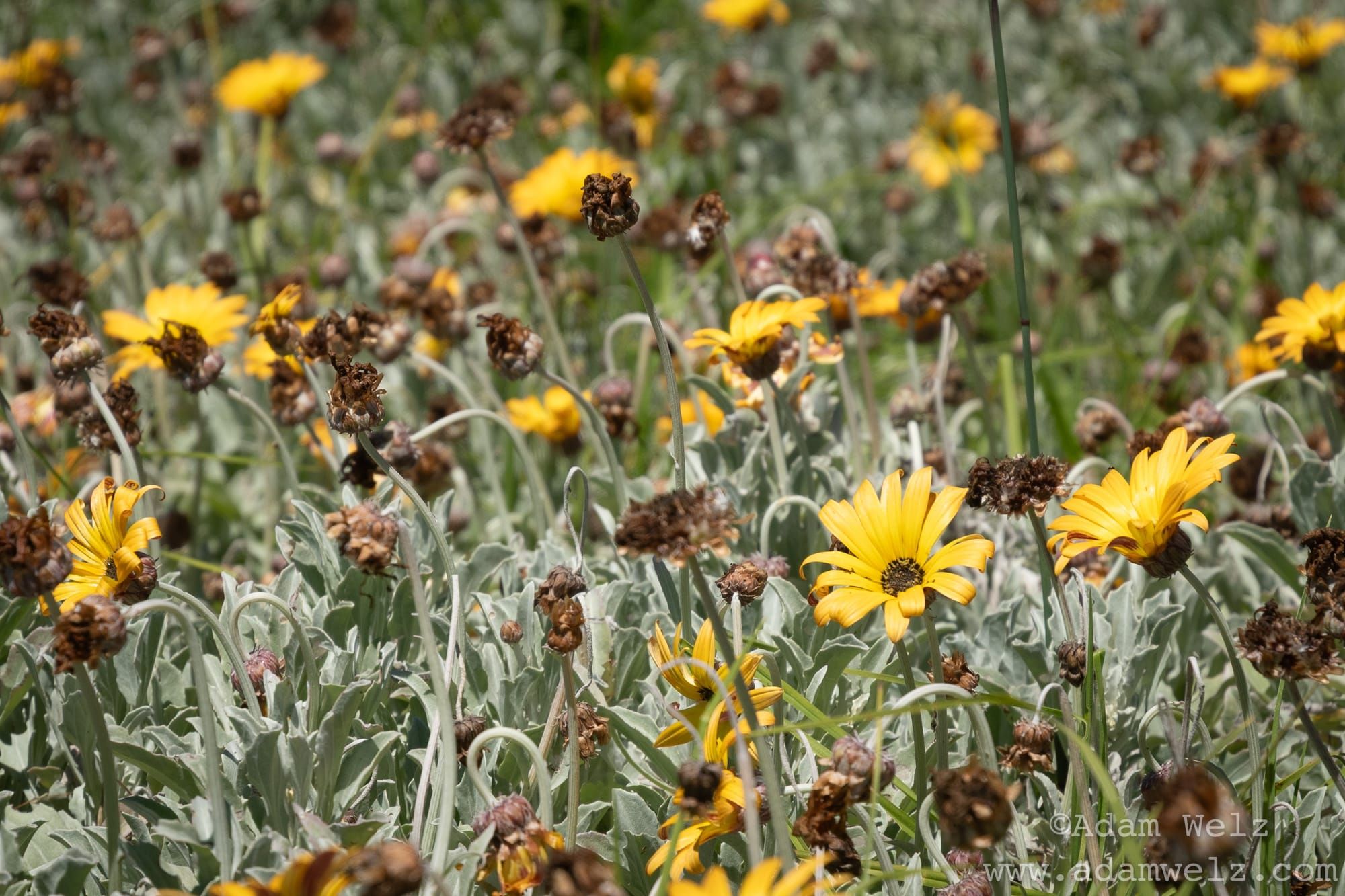
The plant in question, shown in the photo above, is a pretty yellow Arctotis daisy that’s spreading from the boundary fence of a housing complex, forming a dense mat that excludes most other plants.
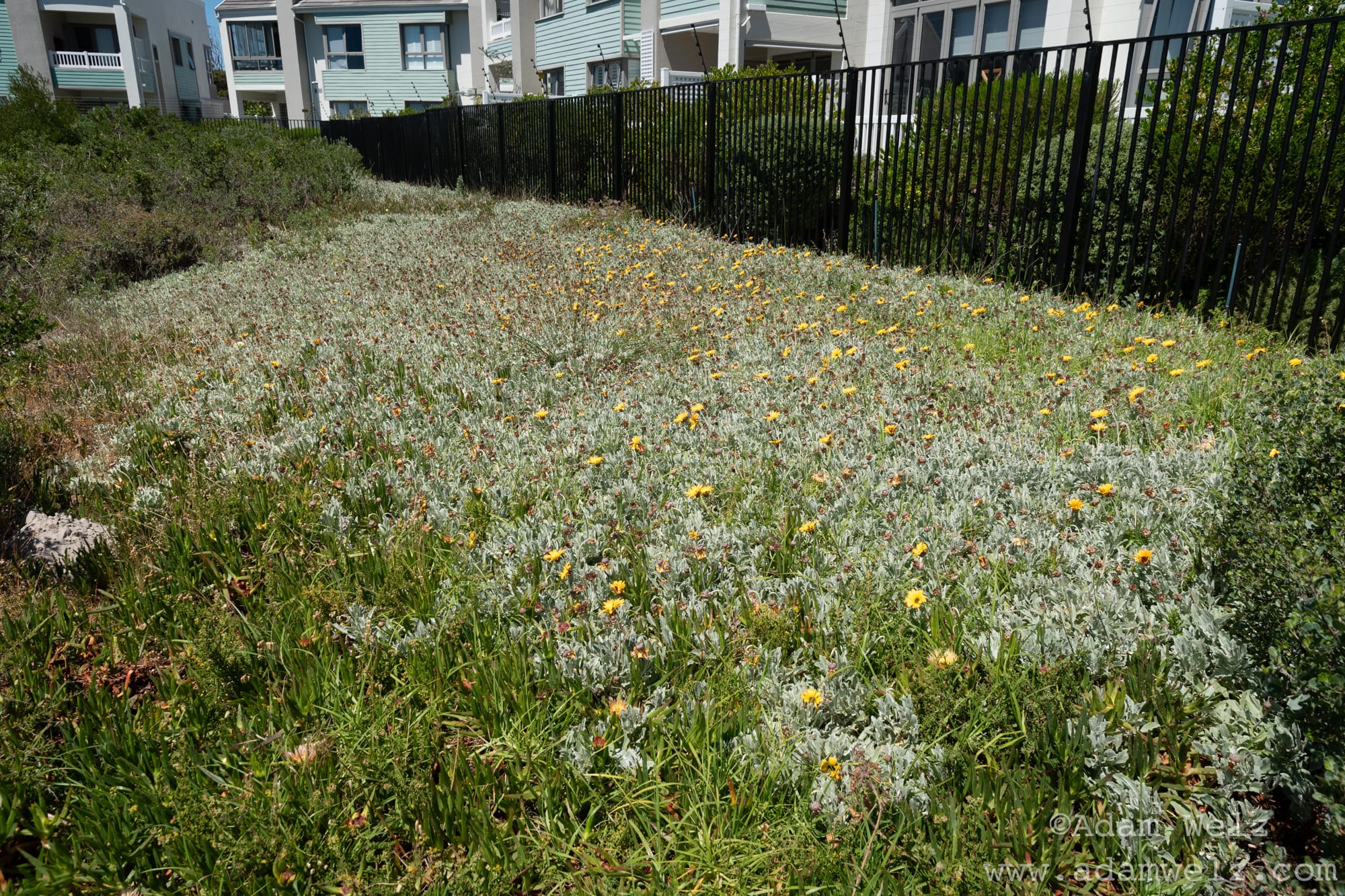
There are many Arctotis species indigenous to South Africa, and some are naturally found in the Kommetjie area. But this is not one of the local types. It is a hybrid, almost certainly produced by artificial crossing in a greenhouse somewhere, and it’s spreading vigorously and pushing other species out in the same way that invasive species from other continents do — those species from Australia and elsewhere that South Africa spends so much money to try to eradicate.
If you walk in wild areas around Cape Town you’ll see more and more artificial hybrids of South African species as well as pure South African species from elsewhere in the country establishing themselves and becoming invasive here. These native aliens, pseudigenous plants or fake natives (whatever you prefer to call them) are almost all products of the so-called “indigenous” gardening industry.
As I’ve written before, plants don’t respect human property lines. They and/or their seeds and pollen often escape from the plots of land we place them into.
If we want to protect our wild species and natural ecosystems, we must become a lot more discerning about what we plant in our gardens and parks. We need to acknowledge that many invasive, ecologically-damaging plants come with “indigenous” labels attached.
The South Peninsula Nature Alliance is raising awareness of this problem, documenting native alien and pseudigenous plants on iNaturalist, and will soon begin to combat the most damaging ones in this area. Subscribe to this newsletter to keep up with our work and feel free to email us via the contact form on this site if you’d like to support our work.
See you in the fynbos!
Adam
P.S. You can read a longer, more detailed post on native aliens and Frankenflora here: https://adamwelz.ghost.io/too-little-space-native-aliens-and-frankenflora/
©Adam Welz / www.adamwelz.com
If you'd like to get this newsletter free whenever a new instalment is published, click on any of the Subscribe buttons on this site, enter your name and email address, then confirm your subscription in your inbox. Signed-in members can also leave comments under newsletter posts.
Follow the SPNA on Instagram at www.instagram.com/komfynbos/
Check out Adam Welz's nature photography at www.instagram.com/adamwelz.wild
None of the writing or photography on this site was produced with or by generative AI. All the typos, grammaticals & inelegant sentences are the author's.