Too Little Space, Native Aliens and Frankenflora
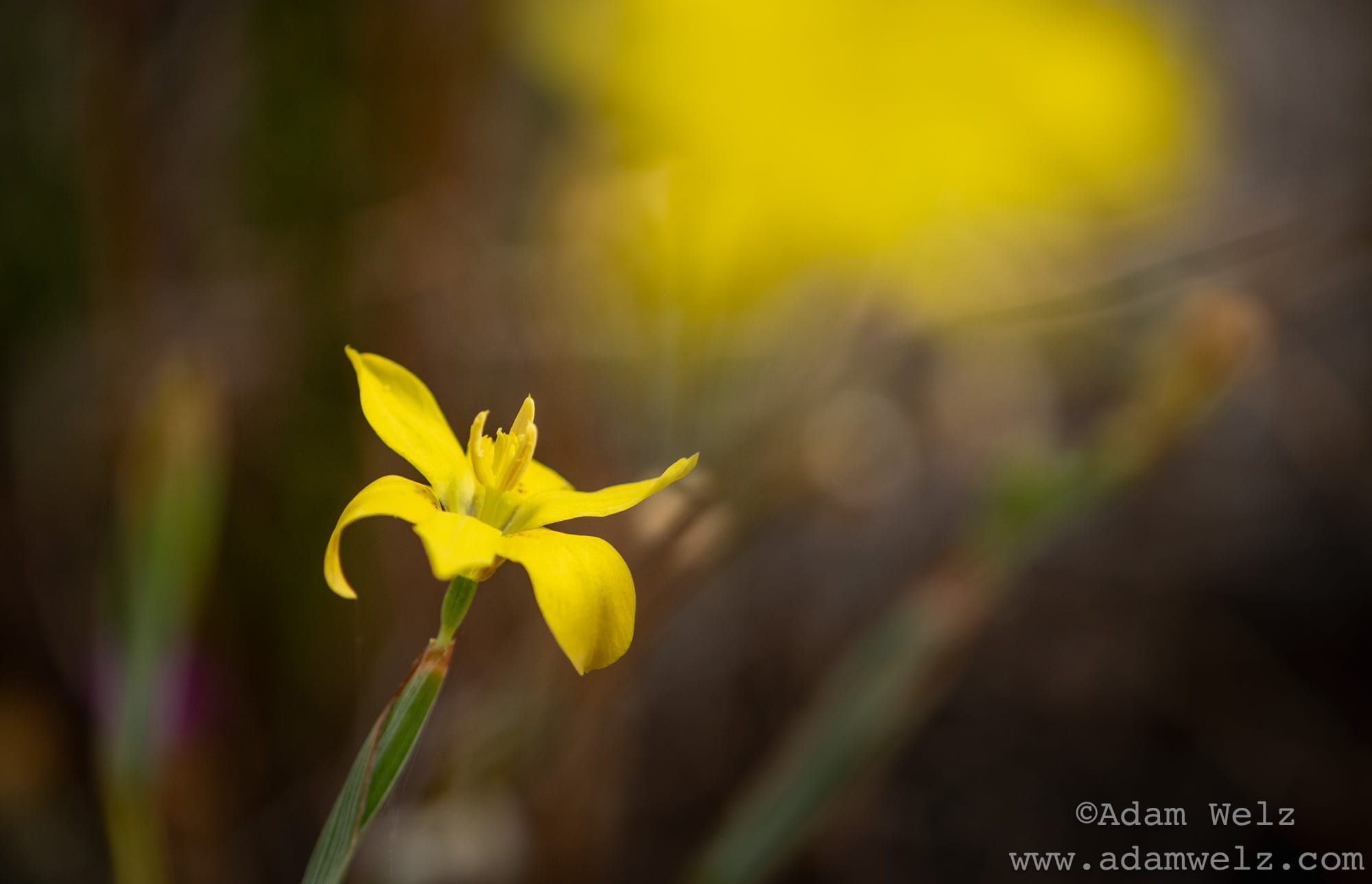
I live in Cape Town, in the heart of the Cape Floristic Region of South Africa, one of the most naturally diverse areas of the planet. The Cape Town Metro area contains about 3,400 indigenous plant species, more than are found in many U.S. states and more, even, than are found in some entire countries. [Shakes head in pity at Denmark, Sweden, Portugal, Switzerland…] About 200 of the city’s plants are endemic; they are naturally found only within its metro borders and nowhere else on Earth.
Many of our indigenous plants are not just fascinating and beautiful, they also have traditional medicinal uses and deep cultural value. They support our growing tourism industry and cover our watersheds, helping to deliver clean water to our growing human population. They protect us from some of the worst effects of climate breakdown and provide food and shelter for an equally special array of wild animals, big and small.
But, despite their undeniable value, our wild species are under assault. Every day bulldozers destroy more nature to make way for relentless urban expansion, both legal and illegal. Invasive alien species are continually spreading, suffocating our natural ecosystems. Climate breakdown is already pushing some species out of their habitats. Too-frequent fires, litter, and water pollution are taking their toll, too.
I could, of course, write this about many other places in the world, and — as in many other places — Cape Town does have professional conservationists working for government departments and NGOs whose job it is to protect these species.
But there are not enough professional conservationists here and they’re having limited impact.
The list of Cape Town species facing extinction, already hundreds long, is growing all the time. Some plant species are down to just a few individuals surviving in one or two tiny patches of land, and at least 13 of the metro’s species are already extinct — gone forever. There are dozens of threatened species within a ten minute walk from my house, as there are for most houses in the city.
The hard truth is that many of Cape Town’s species don’t have enough natural habitat left to ensure their survival in the long term. They need more space, so we must allow them to live in our yards and public parks to give them a fighting chance. This means, among other things, cultivating indigenous plants in these spaces. In the Cape, as in many other places around the world, this is not just a silly exercise in trendy horticulture or woke aura-polishing; it is truly meaningful. It can be the difference between species going extinct or surviving so that following generations can benefit from and enjoy them.
I’m by far not the first person to blare my vuvuzela about the idea of growing indigenous plants. Indigenous gardening has been promoted across South Africa for decades and nurseries all over Cape Town sell plants with “indigenous” labels on them.
But, as I’ve unfortunately discovered, it’s still very difficult for me to create a garden in my yard or in a local park that actually helps to save species from extinction and actually supports natural ecosystems.
Why? Well, the sobering fact that many gardeners, horticulturists, landscape architects (and even conservationists) don’t want to talk about is that a large amount of the “indigenous gardening” you see in the Cape is actually fake. Much of it is actually what I call pseudigenous, and sometimes it is actively harming wild species and natural ecosystems.
When you go to your local nursery and buy plants from the “indigenous” section or hire a landscaper to create an indigenous garden, you’re often getting something that’s either not helpful to local ecosystems and wild species or is outright bad for them.
I’ve come to the disappointing realisation that the “indigenous” gardening industry is not, on the whole, set up to do the right thing.
To understand this problem we must first clarify what the word indigenous means when referring to plants. (The words indigenous and native mean exactly the same thing in this context, but one or other word is preferred in different parts of the world.)
Indigenous means naturally — without human intervention — occurring in a specific area, ecosystem or habitat. The second part of that definition is important; using the word indigenous without accurately defining the area a plant is indigenous to can cause a whole lot of grief.
In my experience, most Cape participants in the horticulture and gardening industries — nurseries, landscapers, gardeners etc. — don’t clearly or accurately define where a plant is indigenous to, and many (if not most) plants sold here with indigenous labels on them are not naturally found in the metro area. Many are indigenous to other parts of the Western Cape, other parts of South Africa, or even other countries in Africa.
Also, many "indigenous" plants sold here are artificial cultivars or hybrids, created by people selectively breeding or cross-breeding species from southern Africa. Although their parent plants were perhaps indigenous to somewhere on the subcontinent, these synthetic creations are “indigenous” only to horticultural greenhouses, in other words not indigenous at all.
So indigenous labels are often misleading. They’re plastered on to plants for promotional purposes, to attract buyers who want to do the right thing but who don’t know enough to avoid being ripped off.
When I point this out to folks in the plant business, I often get told that I’m an uptight purist who’s getting upset about nothing, a joyless botano-Nazi who’s strutting around with a prickly stick up his arse while calling the cops on their garden parties. But this is no trivial semantic neurosis of mine. A growing body of evidence demonstrates that plants that are indigenous to other parts of southern Africa, as well as hybrids and cultivars of those plants, can actually be more harmful to Cape Town’s wild species than so-called alien species from distant continents.
I’ll state that again, because it surprises many people: planting “indigenous” plants from outside your local area, or hybrids and cultivars produced from indigenous plants, can actually be just as bad as or even worse for our wild species and natural ecosystems than planting ‘real’ alien plants from, for example, Australia or Europe.
How can this be, you ask?
It helps to consider that one of the main reasons that some alien species become invasive in the Cape Town area, spreading out of control and suffocating our ecosystems, is that they have essentially no natural enemies here. Consider for example an Australian species like Port Jackson Willow (Acacia saligna), a very troublesome invasive in the Cape, which evolved over millions of years in, well, Australia. While it was evolving over there, a range of insects, mammals, funguses, etc. evolved alongside it to become well-adapted consumers a.k.a. natural enemies of it.
If you bring a plant from Australia and let it loose in the Cape the chances are pretty good that very few, if any, local insects, animals, diseases etc. will attack it because our local species simply have not had the time and opportunity to evolve the required capabilities.
Therefore many alien species are not held back by natural enemies as they would be back home; if the Cape environment suits them in terms of soil, temperature, and rainfall and so on, they can multiply and spread unconstrained.
Then consider that South Africa has many different natural environments, habitats and ecosystems — whatever you want to call them — within its political borders. The thicket ecosystems of the Eastern Cape or the coastal savannas of KwaZulu-Natal are very different from Cape fynbos ecosystems and they have very few species in common. Bringing a plant from other parts of South Africa to the Cape is, in ecological terms, very much like bringing a plant all the way from another continent to the Cape. Safely away from its natural enemies, it can spread uncontrollably and disrupt our ecosystems in the same way.
Every day people take home “indigenous” plants that can spread their runners or seeds beyond yard fences and become a problem. Non-human life-forms don’t care about our property lines.
So the first problem is that South African species can become harmful within their own country by invading ecosystems that they didn’t evolve in. Just because a plant has a little South African flag on its label doesn’t mean it’s safe to grow where you live. So-called “native aliens” have received very little attention overall, but in recent years scientists at Stellenbosch University have begun to write about and research the issue. They have already documented dozens of such species within South Africa. Even I have documented South African species that are not indigenous to my area spreading on nearby conservation land, such as Weeping Anthericum (Chlorophytum saundersiae), which was brought here from eastern regions of South Africa by the pseudigenous landscaping industry.
Problem number two is weirder and even less acknowledged by the “indigenous” gardening industry, but it’s no less serious. It involves mutants of a vegetal kind, and I first wrote about in 2005 after being tipped off by Tony Rebelo, a well-known Cape botanist.
We know that organisms of different species can sometimes cross-breed and create hybrid offspring. Put a male zebra and a female horse in the same kraal for a while and you may end up with a baby zorse. Ligers and tigons are real things, too. Horticulturists realised centuries ago that they could take pollen by hand from one species of plant and use it to pollinate a different but related species, thus artificially creating hybrid offspring with new colours and forms not found in nature. A multi-billion dollar industry now makes and sells a massive number of hybrid plants to gardeners around the world. (I’ll get into why the industry sells so many of these plants instead of natural species in another post sometime.)
Most people don’t realise that they can unintentionally help to create hybrids by gardening with relatives of their locally-indigenous species — and that these mutant plants are becoming a real conservation problem.
Imagine that you’re a Cape Town gardener who wants to grow a protea bush in your yard because proteas are iconic and attractive Cape plants, it’ll attract pollinators, and you want to show some SA pride. You go to the local garden centre’s indigenous section and pick out a protea with a nice label, something like the plants in this photo:
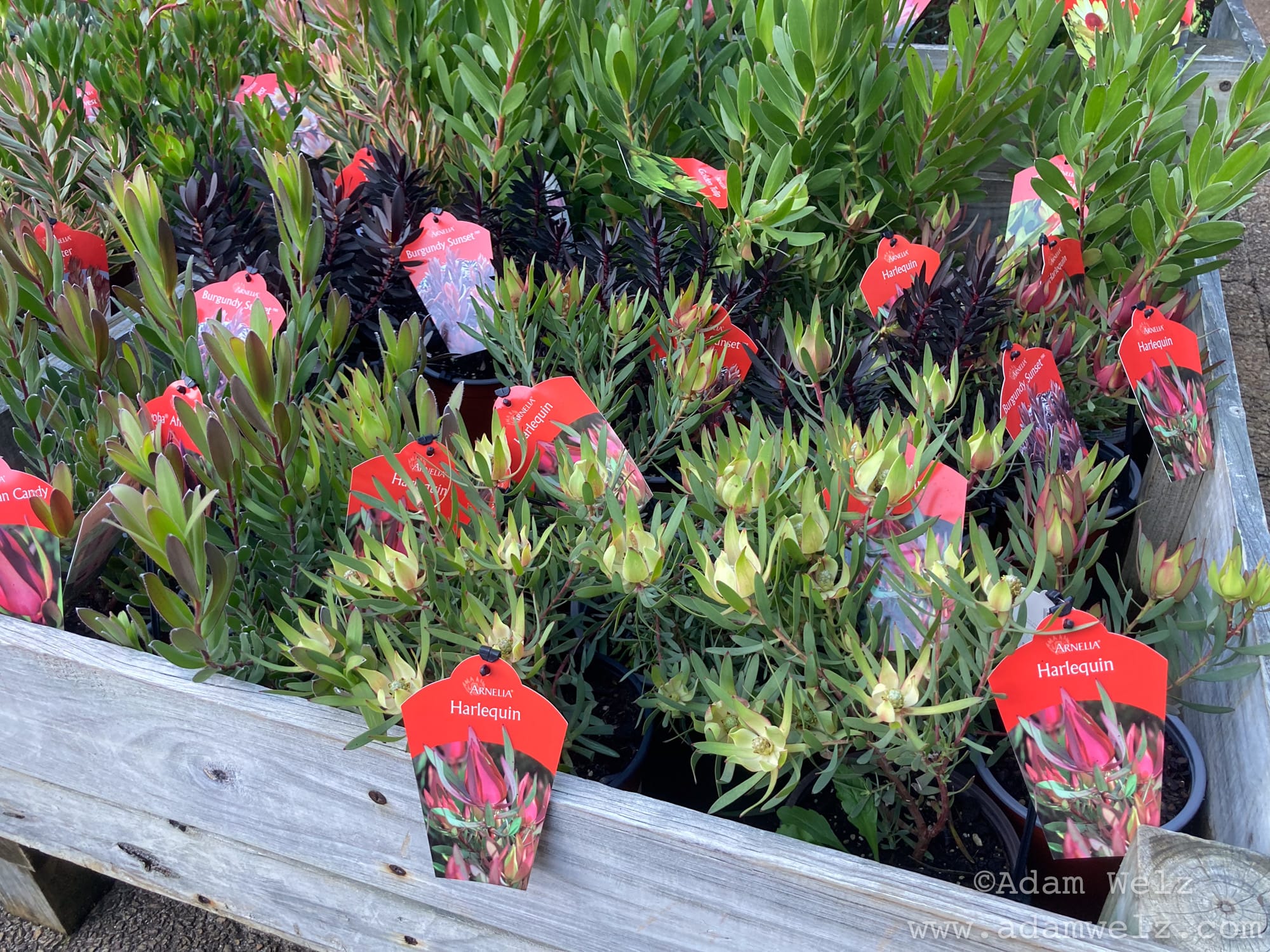
What no-one tells you is that the protea you just bought could be bad for wild proteas growing in conservation areas because, although the plant you bought is not the same as the local wild plants — maybe it’s a cultivar or a species from somewhere else in South Africa — it’s sufficiently closely related to nearby wild plants to hybridise with them.
Pollinators e.g. sunbirds can fly into your yard, pick up pollen from your garden-centre protea, and — because pollinators don’t respect property lines — take it into nearby wild areas and pollinate wild proteas with it. This will cause the wild plants to produce hybrid seeds, which will grow into hybrid plants.
As more and more hybrids are created and spread through the landscape, the pure wild forms will become rarer and may ultimately become extinct, overwhelmed by genes from gardens.
This is not just a theoretical risk. Botanists began finding so-called Frankenflora protea hybrids all across the fynbos region when the Protea Atlas Project kicked off in the 1990s. They soon realised that they resulted from horticultural varieties and non-local proteas being planted in or near areas of natural fynbos. Almost 50 (!) hybrid forms of Protea have been recorded in the wild in the Western Cape to date, hybrid Gladiolus have been recorded, as well as other types.
Thinking about the problems of native aliens and Frankenflora leads to some interesting and perhaps counter-intuitive conclusions. For example, if you want to select plants for your yard that won’t disrupt nearby wild ecosystems, the first question you should ask is not “are these plants indigenous to South Africa?” Instead, you should start by asking “will these plants reproduce and spread within nearby wild areas, and can they hybridize with local wild species?”
You’ll quickly realise, as I have, that whether a plant is indigenous to South Africa or not isn’t the most useful information in making these determinations. In fact, many alien a.k.a. exotic plants are unlikely to spread and are too distantly related to local indigenous plants to hybridise with them, and so aren’t dangerous to local natural ecosystems in the way that South African species can be. Growing a not-at-all-indigenous ornamental rose cultivar in my Cape Town garden can (in this sense, at least) be ecologically better than growing many plants on sale in the indigenous section of your local nursery.
In my experience, most people in the so-called ‘indigenous’ garden industry don’t give a flying patootie about preventing the spread of native aliens or Frankenflora, so you can’t get useful advice or plants from them. In fact, a surprisingly large number of Cape landscape architects, garden designers, nursery owners etc. know very little about their local wild plants or fynbos ecology. They don’t walk in the veld and learn to identify local plants, and they aren’t curious about how species evolve or how natural ecosystems work. They're full of excuses about why they can't plant locally-native plants grown from locally-collected seeds and cuttings. They’re embedded in an industry that's set up to sell indigenous plants but doesn’t care about the ecosystems they come from, an industry that’s all about extracting value from nature without giving back.
This leaves me, a Capetonian who wants to help wild species thrive and support what little of our natural habitat remains, with some interesting problems to solve before I can create the garden of my desires. At a minimum I need to figure out which plants won’t become invasive and won’t hybridise with local wild species, which means I first need to figure out what the local wild species are. Then I need to figure out where to get the plants I need, and how to help them thrive.
None of this is currently as easy as it should be but, after years of thinking about this stuff, I have some ideas about how to start. Use the Subscribe buttons on this page to sign up to the South Peninsula Nature Alliance newsletter and follow along as the project evolves.
Cheers!
Adam Welz
©Adam Welz / www.adamwelz.com
Follow the SPNA on Instagram at www.instagram.com/komfynbos/
Check out Adam Welz's nature photography at www.instagram.com/adamwelz.wild
None of the writing or photography on this site was produced with or by generative AI. All the typos, grammaticals & inelegant sentences are mine.